Breathe more. Spend less.
Live greener.
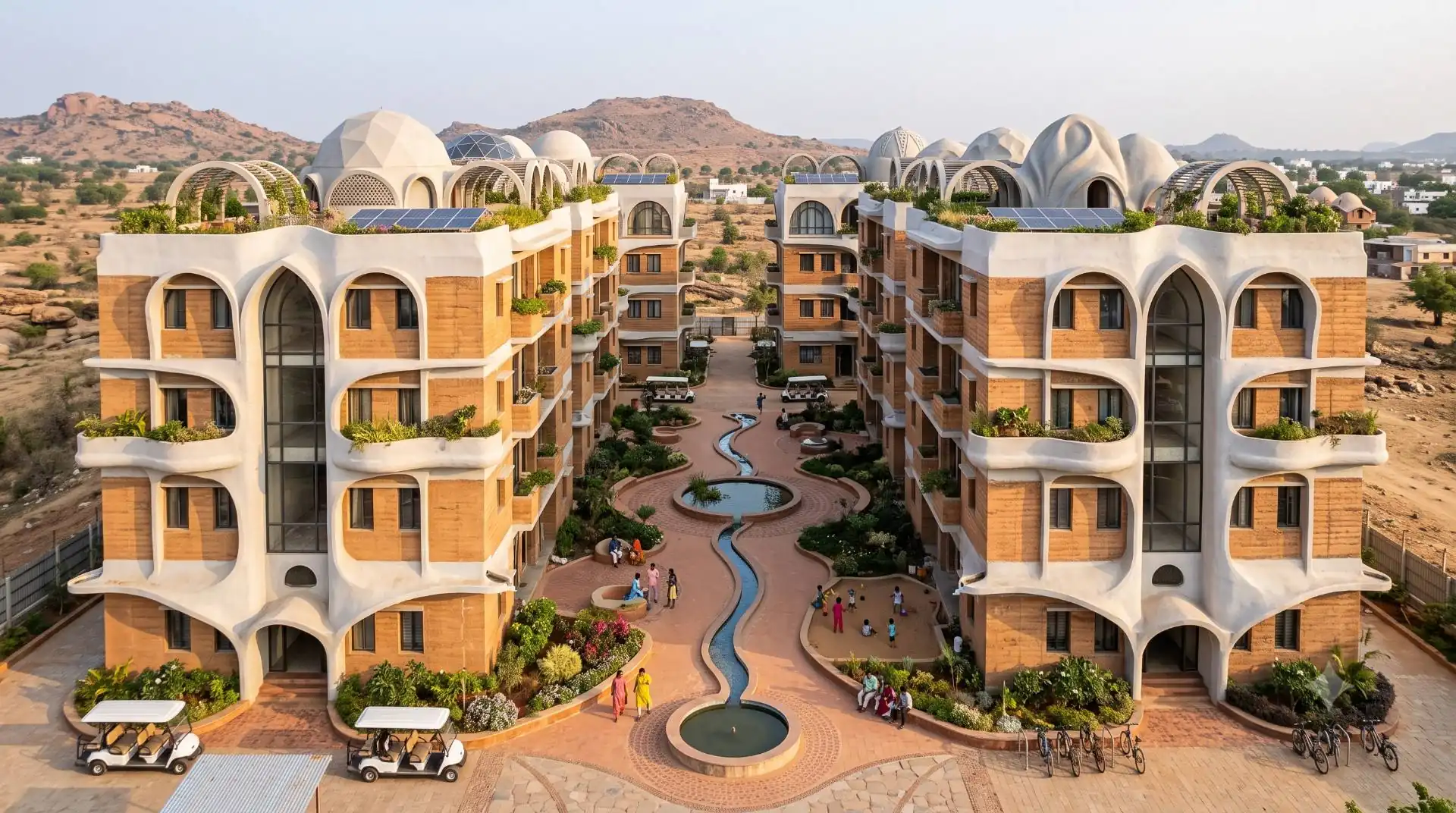
House construction in Hyderabad with earth blocks
- 2× stronger
- 12× less CO₂
- Proven since the 1990s
Compared with country-fired bricks. Source: Auroville Earth Institute, in Auroville conditions. Hyderabad numbers will come from our own tests.
Concept illustration, not a ZB EcoTech project
Tell us what you’re planning. We’ll guide you from there.
People come to us at very different points. Pick the one closest to yours.
I have a plot and want to build a home
A family home, a farmhouse or a weekend place on land you own. We test the soil, design around how you live, and build.
By ZB EcoTech Infra
Farmhouses →I’m planning a layout or several homes
A farm-stay, a gated layout or a cluster of homes. We shape earthen buildings around your idea and build them.
By ZB EcoTech Infra
I’m building and need blocks or a soil test
You have a builder or architect. We test your soil, supply earth blocks, or bring the press to your site.
By CJ EcoTech Supply
I’d like to build alongside like-minded families
Not sure where to build, or would rather build with neighbours who share your values? Join the eco-community waitlist.
By ZB EcoTech Infra
The questions people ask before building with earth.
Choosing something other than a concrete house is a big decision. Here are straight answers to what usually holds people back.
Is it strong enough?
Yes. The Auroville Earth Institute measures an average dry strength of 7.5 MPa for well-made blocks, about twice that of country-fired bricks (3.5 MPa). They have been used there for buildings as large as a four-storey apartment block. These are Auroville’s numbers, from Auroville conditions; Hyderabad numbers will come from our own tests once our first batches finish curing.
Will it survive the monsoon?
Yes. The cement in the mix stabilises the blocks. Like any wall, they last longest with a raised plinth, good roof overhangs and proper drainage, and we design for all three.
Will it be cooler than a concrete house?
Thick earth walls absorb the day’s heat slowly and release it at night, which keeps rooms more comfortable through Hyderabad’s summers.
Has anyone actually lived in one?
Yes. Earth-block buildings have been built and lived in for decades, including at Auroville, where the press we use was developed with the Auroville Earth Institute. Read their notes on earth blocks
Is a CSEB house the same as a mud house?
It’s a modern kind of mud house. A traditional mud wall is unstabilised soil, which needs regular care in heavy rain. A CSEB is soil mixed with a little cement and pressed hard in a machine, so it’s stronger, more regular and stands up to the monsoon.
Do you build the whole house, or only supply blocks?
Both. ZB EcoTech Infra builds turnkey: design, materials and labour, from the soil test to handover. If you have your own builder, our sister company CJ EcoTech Supply can supply the blocks or test your soil.
Can I start small?
Yes. Some people start with a compound wall, a garden room or one feature wall before building a whole home.
What is a Compressed Stabilized Earth Block?
A CSEB is formed by compressing a mix of local soil, a small proportion of a stabilizer such as cement or lime, and water under high pressure. The result is a dense, precise, load-bearing block that needs no firing — cutting out the kiln, the fuel, and much of the carbon that goes into a conventional fired brick.
People often call it a mud house. It’s a modern one: the soil is stabilised and pressed, so the walls stand up to the monsoon. It’s one of the greenest, most natural ways to build a house in Telangana, and it’s how ZB EcoTech Infra builds eco-friendly homes, turnkey, with blocks from our sister company, CJ EcoTech Supply. Mud house vs concrete house →CSEB house construction →
Wherever you are in your plans, there’s a sensible next step.
Read our plain guides: CSEB vs bricks and blocks, mud vs concrete houses, and building permission in Telangana.
Read the guides →Find out whether your soil suits earth blocks, and which mix, before you decide anything else.
Ask about a soil test →We visit your plot, talk through what you want to build, and tell you what it would take.
Plan my home →Tell us where you’re starting from.
Leave your number and a line about your plot or project. We’ll call you back, usually within two working days, and talk through what would suit it.